

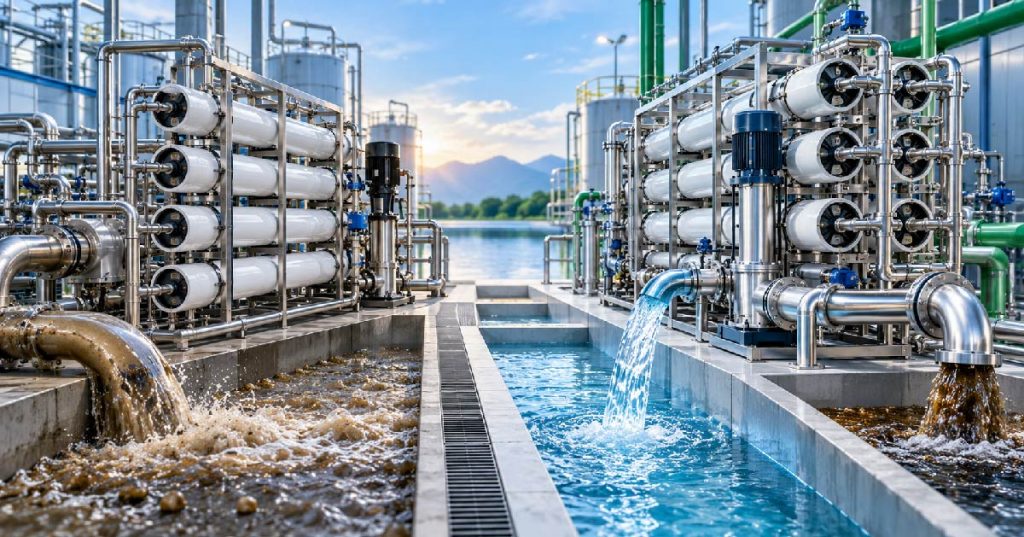
High-TDS wastewater rarely behaves like clean process water. Salt concentration shifts, suspended matter changes, organics enter the stream and operating conditions vary from one production cycle to another. A reverse osmosis plant designed around relatively stable feed water can therefore find itself operating very differently when asked to handle concentrated industrial effluent.
This is where the choice between conventional RO and PF/DT reverse osmosis becomes important.
Both technologies use membrane separation, but they are not designed around exactly the same feed conditions. For relatively clean, well-pretreated water, conventional RO remains highly useful. When the feed becomes more complex, however, high TDS wastewater treatment may call for a system built to tolerate greater variation and more difficult contaminants.
Why High-TDS Wastewater Is Difficult for RO
Total dissolved solids are only part of the story.
Industrial wastewater is difficult due to the presence of dissolved salts, suspended solids, colloids, organic compounds, hardness and contaminants resulting from the production and cleaning process. The process of concentrating water through RO also concentrates these components on the reject side of the system.
This leads to two possible problems which are well known: scaling and fouling of the membrane.
Therefore, conventional industrial reverse osmosis systems are typically equipped with an appropriate pretreatment unit. The cleaner the feed arriving at the membrane, the easier it is to run a stable process. However, some wastes simply won’t behave.
For example, a pharmaceutical plant might have varying organic loads; chemical or textile production causes major changes in wastewater composition. Landfill leachate presents a completely different set of contaminants.
In this case, the requirements are not just high salt rejection membranes but rather high end RO configuration for tough feed conditions.
How Conventional Reverse Osmosis Works
Conventional RO commonly uses spiral-wound membrane elements. Water enters the membrane pressure vessel, permeate crosses the membrane surface, and dissolved salts and other rejected contaminants become concentrated in the reject stream.
It is a well-established arrangement that finds regular applications in desalination, producing process water, and reclaiming wastewater.
Nonetheless, the common assumption that underlies many standard RO systems is that pretreatment should ensure that the concentration of suspended solids and turbidity, as well as fouling potential, is kept within the required boundaries.
Ion Exchange made a comparison between spiral RO and disc-tube RO and found that conventional spiral RO involves a greater need for pretreatment and more stringent turbidity and Silt Density Index operating conditions.
This difference is particularly crucial in reverse osmosis wastewater treatment, given the significant fluctuations of influent quality.
What Makes PF/DT Reverse Osmosis Different?
PF/DT reverse osmosis uses flat-sheet membrane technology rather than the conventional spiral-wound arrangement.
The INDION PF/DT system from Ion Exchange is designed to treat complex water with relatively limited pretreatment and a compact footprint. According to the product literature, the system produces treated water with very low dissolved solids while addressing particulates, colloids and organic matter present in complex feed streams.
That design philosophy matters.
Rather than depending on more complicated methods of pretreatment in order to handle difficult wastewater like ordinary RO feedwater, PF/DT is designed to be used where treatment of wastewater is challenging.
The system is built to be able to inject chemicals inline and also for CIP cleaning of membranes and pressure performance which help achieve recovery rate. Ion Exchange claims it can remove TDS at a rate of 95%.
PF/DT Reverse Osmosis vs Conventional RO
The easiest way to understand the difference is to look at the operating problem each configuration is expected to solve.
| Consideration | Conventional RO | PF/DT RO |
| Typical membrane configuration | Spiral-wound | Flat-sheet/disc-tube |
| Pretreatment requirement | Usually more extensive for difficult wastewater | Designed for comparatively minimal pretreatment |
| Feed-water variation | Best with controlled feed conditions | Better suited to fluctuating complex feeds |
| Suspended solids tolerance | Relatively limited | Higher tolerance |
| Difficult industrial effluent | May require substantial upstream conditioning | Designed specifically for complex wastewater |
| Membrane replacement | Complete spiral element normally replaced | Individual membrane cushions can be replaced |
| ZLD integration | Possible with appropriate design | Positioned as a precursor to ZLD systems |
Ion Exchange’s published technical FAQ provides useful context. It cites an SDI requirement below 5 and turbidity below 1 NTU for spiral RO, compared with SDI of 15–20 and turbidity below 10 NTU for its disc-tube RO configuration. The company also notes that PF/DT can cope with greater feed-quality fluctuation.
These values should not be treated as universal specifications for every RO plant. They do, however, illustrate why membrane configuration matters when selecting RO for high TDS water.
When Conventional RO Still Makes More Sense
PF/DT is not automatically the better choice simply because TDS is high.
If water has already been well treated and has low levels of solids and organics with stable characteristics over time, a properly designed standard industrial reverse osmosis system should work perfectly fine.
It is important to note that treatment of any water with a high level of TDS must be based on full analysis of the water rather than on the results of one laboratory test.
Two streams of wastewater may have the same level of TDS, but their behavior in terms of fouling might differ considerably.
One stream may contain soluble salts only, while the other may have a significant amount of suspended solids, organics, and various contaminants.
Where PF/DT Becomes Valuable
Ion Exchange identifies applications including landfill leachate and complex wastewater from pharmaceutical, chemical, textile, distillery and tannery operations.
These are exactly the kinds of applications where wastewater characteristics can make membrane treatment difficult.
For an operator, the benefit is not simply “better filtration.” It is the possibility of simplifying the treatment train, producing reusable-quality permeate and reducing the quantity of wastewater that must move to subsequent concentration stages.
In pharmaceutical applications, for example, Ion Exchange positions PF/DT as a treatment step before a Multi-Effect Evaporator in a Zero Liquid Discharge scheme. The system is intended to recover more reusable permeate while sending a concentrated reject onward for evaporation.
That can change the economics of high TDS wastewater treatment because membrane recovery influences how much liquid eventually reaches the energy-intensive evaporation stage.
PF/DT and Zero Liquid Discharge
This is perhaps where the technology becomes strategically important.
ZLD is rarely achieved by one machine. It is a treatment sequence.
Wastewater may pass through biological or physicochemical treatment before membrane concentration, followed by evaporation and solid-waste handling. If RO can recover more reusable water ahead of evaporation, less liquid remains for thermal treatment.
Ion Exchange specifically describes its PF/DT system as a precursor to Zero Liquid Discharge and pairs it with its Multi-Effect Evaporator solutions.
For industries in the UAE, where water reuse and responsible wastewater management have growing operational importance, this integrated approach is more meaningful than considering RO as an isolated piece of equipment. Ion Exchange UAE provides wastewater treatment, reuse and ZLD systems across industrial applications in the region.
Choosing the Right RO for High TDS Water
Start by looking beyond TDS.
Analyse suspended solids, COD, hardness, silica, oil and grease, pH, temperature and how much the wastewater changes during production. Then consider the required recovery and final permeate quality.
If the wastewater is stable and suitable pretreatment is practical, conventional RO may remain the logical choice.
If feed quality varies considerably, pretreatment is becoming complicated, or the RO system has to deal with difficult industrial effluent before a ZLD stage, PF/DT reverse osmosis deserves closer evaluation.
The correct answer comes from the wastewater, not from the membrane label.
How Ion Exchange Supports High-TDS Wastewater Treatment
Ion Exchange’s approach extends beyond supplying an RO skid. Its UAE operations provide integrated water and wastewater treatment solutions backed by engineering, treatment systems, membrane technologies and operation and maintenance support. The company has operated in the UAE for more than three decades and has an ICV-certified assembly facility in Sharjah for customised and standardised treatment systems.
For difficult reverse osmosis wastewater treatment applications, that broader process capability is useful. PF/DT can be evaluated alongside upstream treatment, water reuse and downstream ZLD requirements rather than as an isolated membrane stage.
Final Thoughts
The difference between conventional RO and PF/DT reverse osmosis becomes clearer when the feed becomes difficult.
Conventional RO is well suited to many controlled, adequately pretreated water streams. PF/DT is designed for a different challenge: complex wastewater, greater feed-quality variation and treatment schemes where reliable membrane concentration can support reuse or ZLD.
For high TDS water treatment, the better system is therefore not simply the one offering the highest salt rejection on paper. It is the one capable of operating reliably with the actual wastewater entering the plant.
If your facility is dealing with variable high-TDS effluent, repeated membrane fouling or increasing pretreatment complexity, connect with Ion Exchange experts to evaluate the most appropriate RO and wastewater recovery strategy.
FAQs
What is PF/DT reverse osmosis?
PF/DT reverse osmosis is a membrane treatment configuration based on flat-sheet membrane technology. Ion Exchange designed its INDION PF/DT system for complex wastewater streams that may require less extensive pretreatment than conventional spiral-wound RO.
Is PF/DT better than conventional RO for high-TDS wastewater?
It depends on feed quality. Conventional RO can work very effectively with stable, appropriately pretreated water. PF/DT can offer advantages where wastewater contains higher suspended solids, fluctuating contaminants or other characteristics that make conventional RO operation difficult.
Can RO treat high-TDS industrial wastewater?
Yes. RO for high TDS water is widely used, but membrane selection, operating pressure, pretreatment and recovery must be matched to the actual wastewater composition.
Does PF/DT require pretreatment?
Some pretreatment is still required. Ion Exchange describes its PF/DT system as requiring minimal pretreatment and cites multigrade and cartridge filtration in its treatment approach.
Can PF/DT be used in a Zero Liquid Discharge plant?
Yes. Ion Exchange positions PF/DT as a precursor to ZLD, where the RO stage recovers reusable permeate and concentrated reject can subsequently be treated by systems such as a Multi-Effect Evaporator.