

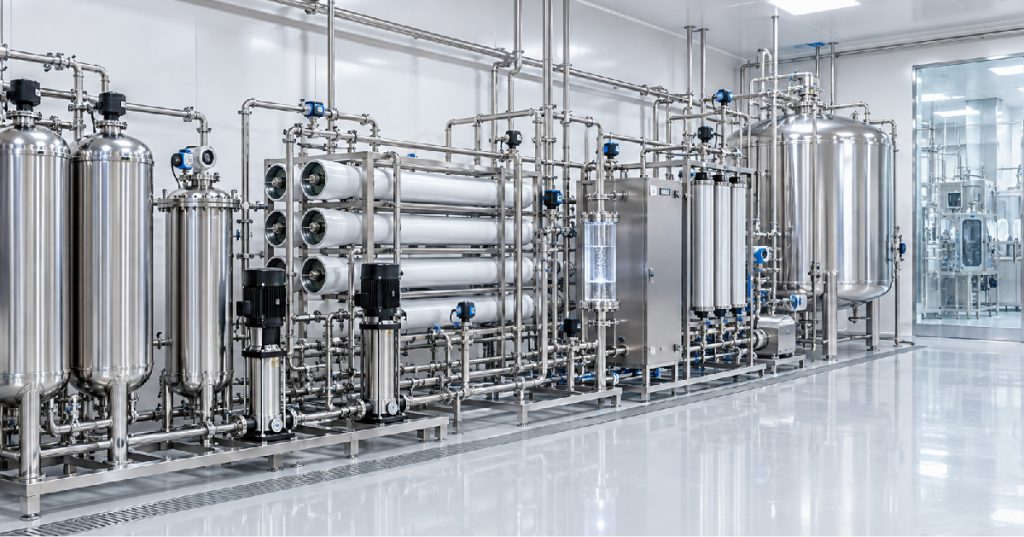
In pharmaceutical manufacturing, water is far more than a utility. It can become an ingredient, cleaning medium and process input, which means poor water control can surface as microbial risk, inconsistent batches, failed validation or production delays. A well-designed pharmaceutical water treatment system does more than purify incoming water. It creates a controlled, repeatable supply that supports high-purity production without making the plant harder to operate.
The key question is, “What water quality does each process require, and how do we maintain it consistently?”
Why Pharmaceutical Water Quality Demands More Control
Pharmaceutical manufacturing facilities utilize water in different quality grades. Some uses can engage water that is acceptable to drink while other cases require purified or injected water. The FDA states that USP-grade purified or injected water is used as components of medicines, with respective grades being selected with regard to the intended use. WFI is water that is produced either through distillation or by a purification process that is as good or better in removing impurities.
That makes water for pharmaceutical use a risk-management issue as much as a treatment issue. Conductivity, total organic carbon, microorganisms, endotoxins, dissolved solids and particles may all matter depending on the end use. A pharmaceutical water purification system therefore has to be designed around the process, not around a standard equipment package.
How a Pharmaceutical Water Treatment System Works
A robust system uses multiple treatment barriers because no single technology solves every water-quality challenge.
- Pretreatment: Filtration, activated carbon, softening or ultrafiltration can reduce suspended solids, hardness, chlorine and other contaminants.
- Reverse osmosis: A pharmaceutical RO system removes a large proportion of dissolved salts, organics and particulate contaminants.
- High-purity polishing: Technologies such as continuous electrodeionisation can further reduce ionic contaminants.
- Storage and distribution: Hygienic tanks, circulation loops and sanitisation controls help preserve water quality after generation.
- Monitoring and validation: Instruments, sampling points, alarms and documented procedures help confirm that the system performs as intended.
Ion Exchange’s INDION High Purity Water Systems combine pretreatment, RO and continuous electrodeionisation in configurations developed for pharmaceutical requirements. The company states that these systems are designed around cGMP and GAMP considerations and can support pre-validation requirements.
Choosing the Right Purified Water System for Pharmaceutical Production
A purified water system pharmaceutical facility needs should begin with a clear user requirement specification, not with a catalogue selection. Map where water is used — formulation, rinsing, cleaning, laboratory work or API processing — and define the required quality at each point.
Feed-water fluctuations require equal focus. Seasonal variations in hardness and organics, silica or microbial content can change performance. An excess capacity creates a risk of stagnation and increases capital costs, while a smaller capacity creates pressure at peak production times. A high-purity water system should be designed taking into account real needs in terms of quantity of water required, circulation and recovery, and future expansion plans.
This difference is important because having a surplus of capacity does not mean that the system is safer. Good engineering means that the capacity of treatment and design of distribution should match the actual use of the facility.
Where Reverse Osmosis Adds Value
RO is often a central barrier because it can remove dissolved salts, organics, particles and microorganisms. Yet a pharmaceutical RO system should not be judged only by rejection percentage. Membrane selection, pretreatment, recovery, cleaning philosophy, sanitisation and downstream polishing all influence long-term performance.
FDA guidance also stresses that pretreatment, maintenance, monitoring and sanitisation are integral to high-purity water operations. Reliable performance comes from treating the pharmaceutical water purification system as one connected process rather than a collection of isolated skids.
What Ion Exchange Brings to Pharmaceutical Water Management
Overall, Ion Exchange treats its pharmaceutical services as an integrated water management sector that implies generating and distributing pure water, treating process water, creating specialized resin and treating waste water, implementing recycling systems, and developing the Zero Liquid Discharge technology. Apart from that, Ion Exchange has some services related to purification, separation, and concentrating processes in pharmaceuticals and active pharmaceutical ingredients.
This integrated approach matters because a pharmaceutical site rarely has only one water challenge. The same plant may need a purified water system pharmaceutical production can rely on, an effluent treatment plant and a reuse or ZLD strategy. Connecting these requirements early can reduce duplicated infrastructure.
For stronger internal SEO, this section can naturally connect readers to Ion Exchange’s pharmaceutical solutions, water treatment solutions, wastewater treatment and Zero Liquid Discharge pages.
Ion Exchange works closely with pharmaceutical manufacturers across high-purity water treatment and distribution, bulk-drug purification, specialty excipient resins, raw and process-water treatment, effluent treatment and recycle, Zero Liquid Discharge, waste-to-energy, and 24/7 service. This integrated approach highlights an important point: a pharmaceutical water treatment system delivers better long-term value when it is planned as part of the facility’s complete water lifecycle rather than as an isolated utility.
Designing for Reliability, Not Just Commissioning
Getting compliant water on the very first day is just the beginning. The sustainability of the system depends on a combination of factors—sanitary design of the system, circulation and maintenance processes, the efficiency of membranes and resins, and the performance of devices used in the system.
Teams should also monitor processes and be aware of how they are behaving rather than waiting until the reference value is exceeded. Even insignificant changes in values such as higher pressure differential, lower recovery from RO or decline in conductivity can signal a problem in the system.
This is where operations and maintenance become part of quality assurance. A technically sound design that is difficult to sanitise, monitor or service may become an operational burden later.
Build Purity Into the Process
For pharmaceutical manufacturers, water quality cannot simply be checked at the end. It has to be engineered into generation, storage, distribution, monitoring and maintenance from the start. The right pharmaceutical water treatment system should match the required water grade, cope with feed variability, support validation and remain practical to operate over its full lifecycle.
Ion Exchange combines high-purity water expertise with broader water, wastewater, recycle and ZLD capabilities. If you are planning a new facility or upgrading an ageing system, speak with Ion Exchange about a solution built around your process, compliance needs and future capacity.
Frequently Asked Questions
What is a pharmaceutical water treatment system?
A pharmaceutical water treatment system treats source water to a quality suitable for pharmaceutical processing. Depending on the application, it may include pretreatment, RO, electrodeionisation, ultrafiltration, storage, distribution, sanitisation and monitoring.
What is the difference between Purified Water and Water for Injection?
Both are pharmaceutical water grades, but WFI is intended for applications requiring tighter control of chemical and microbiological quality. The correct grade depends on the product and manufacturing process.
Is reverse osmosis enough for pharmaceutical water?
Not always. Reverse Osmosis is often a major treatment step, but higher-purity applications may need additional polishing, microbial control, sanitary storage and distribution, monitoring and validated sanitisation.
How should a high-purity water system be selected?
A high purity water system should be selected after reviewing feed-water quality, required product-water specification, peak demand, sanitisation method, recovery, distribution design, monitoring, validation expectations and future capacity.
Why is water for pharmaceutical use continuously monitored?
Water for pharmaceutical use can change in quality during generation, storage and distribution. Routine monitoring helps detect trends early, maintain process control and support documented compliance with defined water-quality specifications.